How Often Should You Service Your Furnace?
Table of Contents
- The Short Answer
- Why Annual Servicing Matters
- What Professional Furnace Service Includes
- Best Time of Year to Service Your Furnace
- DIY Maintenance Between Professional Visits
- Warning Signs Your Furnace Needs Service Now
- How Much Does Furnace Service Cost?
- When to Stop Repairing and Start Replacing
- Frequently Asked Questions
Your furnace is the hardest-working appliance in your home. During a typical Vancouver winter, it runs 6-8 hours a day for five to six months straight. Yet most homeowners never think about their furnace until it breaks down—usually on the coldest night of the year. Regular maintenance isn't just recommended; it's essential for safety, efficiency, and your wallet.
The Short Answer
Every furnace should be professionally serviced at least once per year. The ideal time is early fall—September or October—before you need it for the heating season. If your furnace is over 10 years old, consider bi-annual checkups: one in fall before the season starts, and one in spring after it's been working hard all winter.
This applies regardless of whether you have a natural gas furnace, propane furnace, or electric furnace. Gas furnaces especially require annual safety inspections because of carbon monoxide risks. At Lord Mechanical, we recommend and perform annual furnace tune-ups for homes throughout North Vancouver, West Vancouver, and the entire North Shore.
Why Annual Servicing Matters
Think of furnace maintenance like an oil change for your car. You could skip it for a while, but eventually the engine pays the price. Here's what's at stake:
1. Safety
A cracked heat exchanger—the component that separates combustion gases from your indoor air—can leak carbon monoxide into your home. CO is odourless and colourless, making it undetectable without proper equipment. A professional inspection includes combustion analysis and heat exchanger inspection to catch these life-threatening issues early.
2. Efficiency
A dirty or poorly maintained furnace works harder to produce the same amount of heat. Clogged filters restrict airflow, forcing the blower motor to consume more electricity. Dirty burners and flame sensors cause incomplete combustion, wasting gas. Annual cleaning and calibration can restore 10-15% efficiency loss, translating to $150-$300 in annual energy savings.
3. Warranty Protection
Nearly every furnace manufacturer requires annual professional maintenance as a condition of their warranty. If your furnace fails prematurely and you can't show service records, the manufacturer may deny your warranty claim—leaving you to pay for what could be a $3,000-$5,000 repair out of pocket.
4. Preventing Expensive Breakdowns
80% of furnace failures are caused by issues that could have been caught during routine maintenance. A $175 tune-up is far cheaper than a $1,500 emergency repair on a Friday night in January. Our technicians regularly catch failing ignitors, worn bearings, and cracked inducer motors during routine inspections—saving homeowners thousands in avoided emergency calls.
What Professional Furnace Service Includes
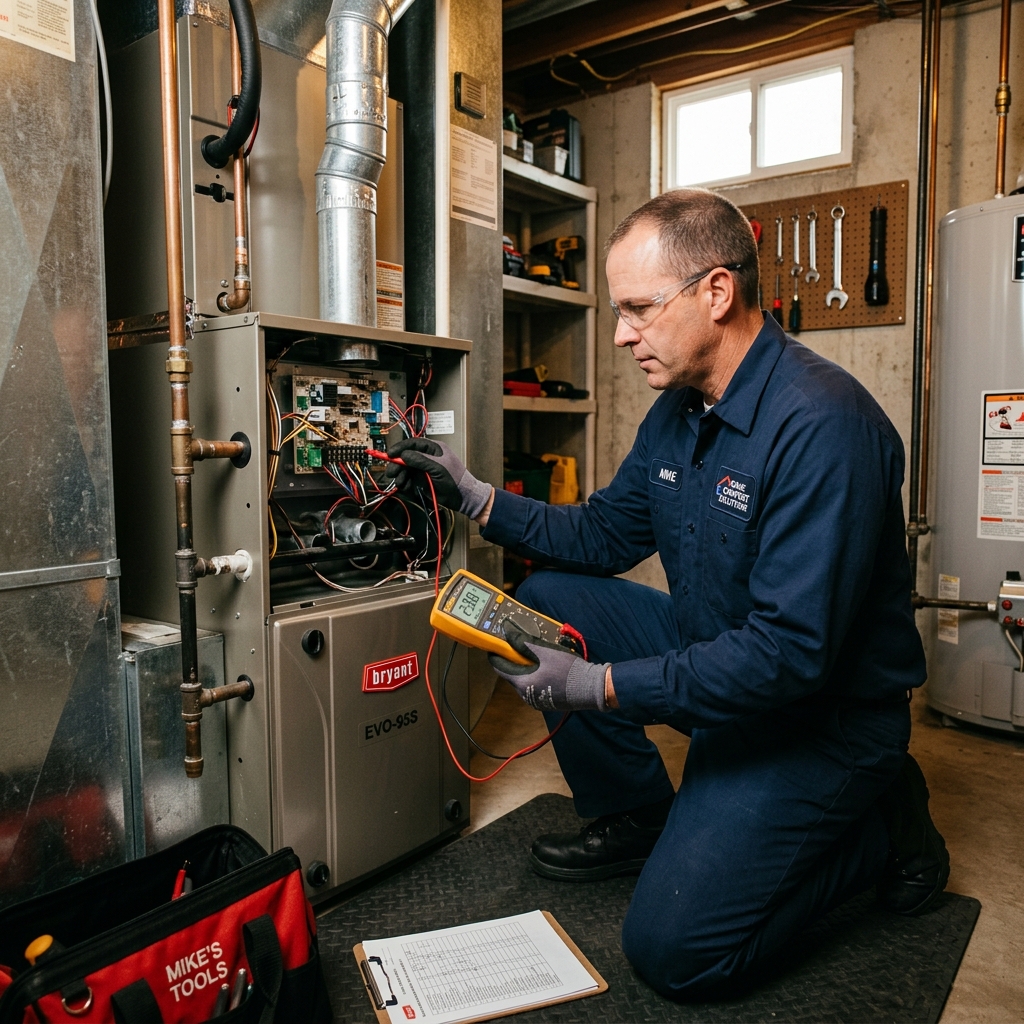
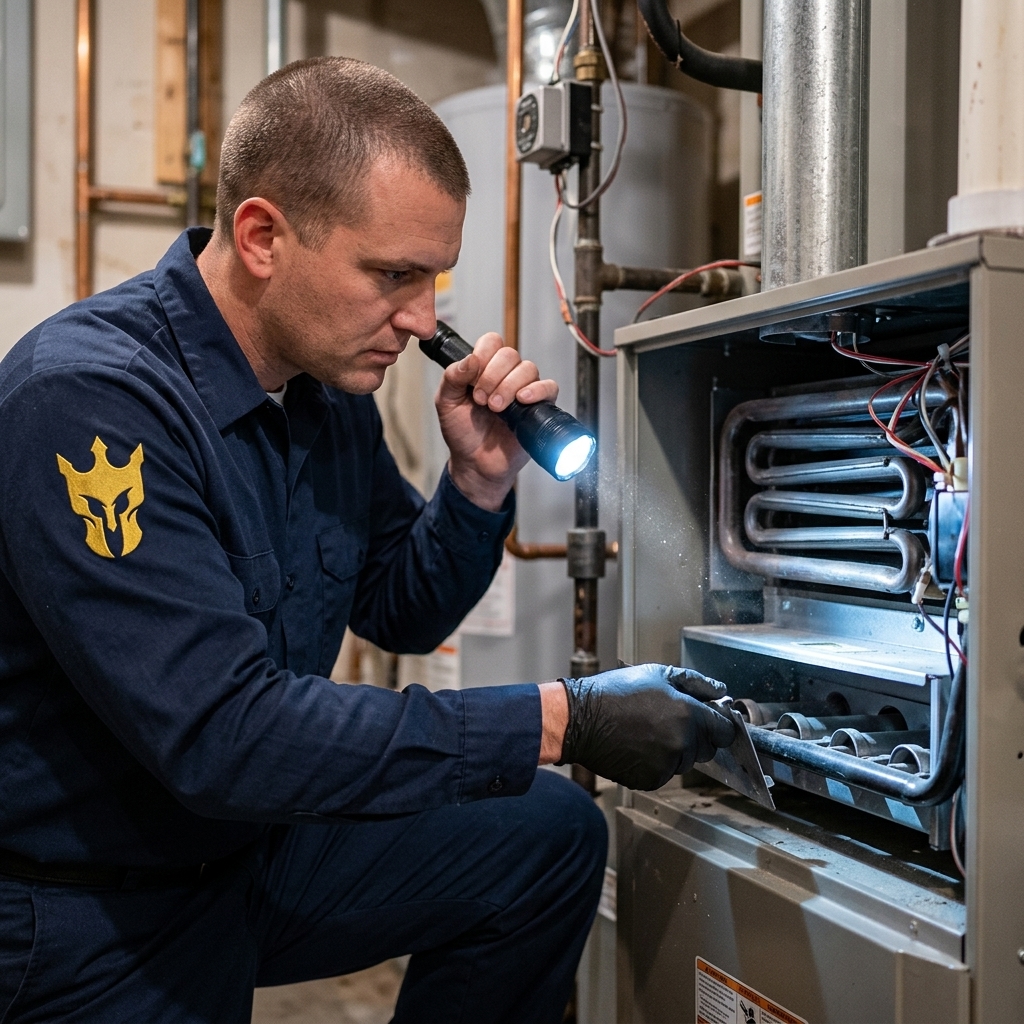
A thorough furnace tune-up by a licensed technician should cover the following:
- Visual inspection: Checking for corrosion, cracks, and signs of wear on all components
- Filter replacement: Installing a new high-quality filter (or cleaning a reusable one)
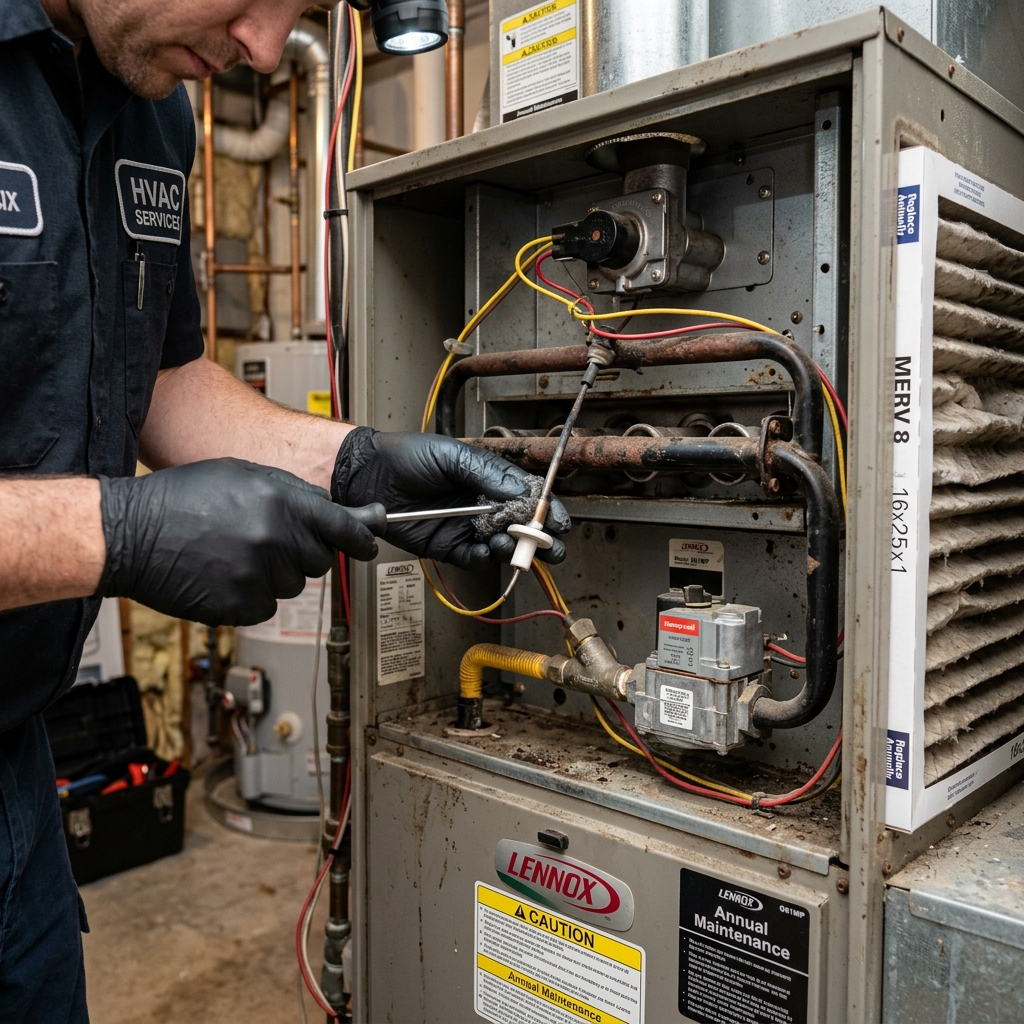
- Burner cleaning: Removing carbon buildup from burners for clean, efficient combustion
- Flame sensor cleaning: Ensuring reliable ignition every cycle
- Heat exchanger inspection: Checking for cracks or separation that could leak CO
- Combustion analysis: Measuring gas-to-air ratios to verify safe, efficient operation
- Blower motor inspection: Checking bearings, lubrication, and electrical connections
- Thermostat calibration: Verifying accurate temperature sensing and control
- Carbon monoxide testing: Measuring CO levels in the supply air and flue gases
- Gas leak detection: Using electronic sniffers to check gas connections and valves
- Ductwork inspection: Checking accessible ductwork for disconnections or damage
- Safety controls test: Verifying all safety switches and shutoffs function correctly
A quality inspection takes 60-90 minutes. Be wary of companies offering "30-minute tune-ups" at bargain prices—they're likely skipping critical safety checks.
Best Time of Year to Service Your Furnace
September and October are the ideal months for furnace maintenance in the Vancouver area. Here's why:
- Before you need it: Catch problems before the first cold snap, not during one
- Better scheduling: HVAC companies are less busy in early fall, so you'll get faster appointments
- Time for repairs: If the inspection uncovers a problem, there's time to order parts and fix it before winter
- Lower urgency pricing: Emergency repairs in December cost more than planned maintenance in September
On the North Shore, we typically see the first heating days in late October. Scheduling your tune-up in September gives you a comfortable buffer.
DIY Maintenance Between Professional Visits
While professional servicing is essential, there are several tasks you can handle yourself to keep your furnace running smoothly between annual visits:
- Change your filter monthly: A clogged filter is the #1 cause of furnace problems. Check it monthly during the heating season and replace it when it looks grey or dirty. Use MERV 8-11 filters for the best balance of filtration and airflow.
- Keep vents clear: Ensure all supply and return vents are unobstructed by furniture, curtains, or rugs.
- Check the area around your furnace: Keep at least 3 feet of clearance around the unit. Never store flammable materials nearby.
- Test your thermostat: If your home doesn't feel as warm as the thermostat setting suggests, the thermostat may need batteries or recalibration.
- Listen for unusual sounds: Banging, squealing, or rattling noises warrant a professional inspection.
- Check your CO detectors: Test carbon monoxide detectors monthly and replace batteries annually.
Warning Signs Your Furnace Needs Service Now
Don't wait for your scheduled tune-up if you notice any of these warning signs:
- Yellow or flickering pilot light: A healthy flame is blue and steady. Yellow indicates incomplete combustion and potential CO production.
- Strange smells: A persistent musty, burning, or rotten-egg odour requires immediate professional attention.
- Increasing energy bills: A sudden spike in gas usage without a temperature change means declining efficiency.
- Uneven heating: Some rooms hot while others are cold indicates airflow or ductwork issues.
- Short cycling: The furnace turns on and off frequently without reaching the set temperature.
- Excessive dust: If your home is dustier than usual, the furnace may have a ductwork leak or filter issue.
- Age: Any furnace over 15 years old should be inspected more frequently and evaluated for replacement options.
How Much Does Furnace Service Cost?
In the Vancouver area, professional furnace tune-ups typically cost:
- Standard annual tune-up: $150 – $250
- Comprehensive inspection (older furnaces): $200 – $350
- Emergency diagnostic: $200 – $400 (includes after-hours surcharge)
Compare that to common repair costs when maintenance is skipped:
- Ignitor replacement: $250 – $400
- Blower motor replacement: $500 – $1,200
- Heat exchanger replacement: $1,500 – $3,500
- Complete furnace replacement: $4,500 – $8,000+
The math is simple: a $175 annual tune-up is the best investment you can make in your home heating system.
When to Stop Repairing and Start Replacing
We follow the "50% rule" at Lord Mechanical: if a repair costs more than 50% of the price of a new furnace, it's time to replace. Other indicators include:
- Furnace is 15+ years old
- Repairs are becoming more frequent (2+ per season)
- Energy bills keep climbing despite maintenance
- Uneven heating or comfort problems persist
- The heat exchanger has cracks
When it's time to replace, consider upgrading to a heat pump instead. With up to $16,000 in BC rebates, a heat pump provides both heating and cooling, lower operating costs, and zero combustion-related safety concerns.
Frequently Asked Questions