AC Installation in North Vancouver: What to Know
Table of Contents
A decade ago, air conditioning in North Vancouver was considered a luxury—something for the odd summer week when temperatures crept past 25°C. Those days are gone. The heat domes of recent years brought 35°C+ temperatures to the North Shore, overwhelming homes designed for mild summers. If you're considering AC for your North Vancouver home, here's everything you need to know about your options, costs, and the smartest way to cool your house.
Why North Vancouver Needs Air Conditioning Now
North Vancouver's climate has shifted noticeably over the past decade. Environment Canada data shows that the number of days exceeding 25°C has doubled since 2010, and the number of days above 30°C has tripled. The urban heat island effect in Lower Lonsdale and Central Lonsdale amplifies temperatures further.
But the heat isn't the only concern. The wildfire smoke seasons of 2023, 2024, and 2025 demonstrated another critical benefit of air conditioning: when you can keep windows closed and still stay cool, you dramatically reduce indoor exposure to hazardous particulate matter. Many of our clients now view AC as a health investment, not just a comfort upgrade.
North Vancouver's housing stock presents unique challenges. Many homes in Lynn Valley, Deep Cove, and Edgemont were built between 1960-1990 without ductwork, making traditional central AC installation complex. Upper Lonsdale and Norgate homes tend to have basements that stay naturally cool, while upper floors bake in the afternoon sun. Understanding these neighbourhood-specific factors is essential for choosing the right cooling solution.
Types of Cooling Systems
Central Air Conditioning
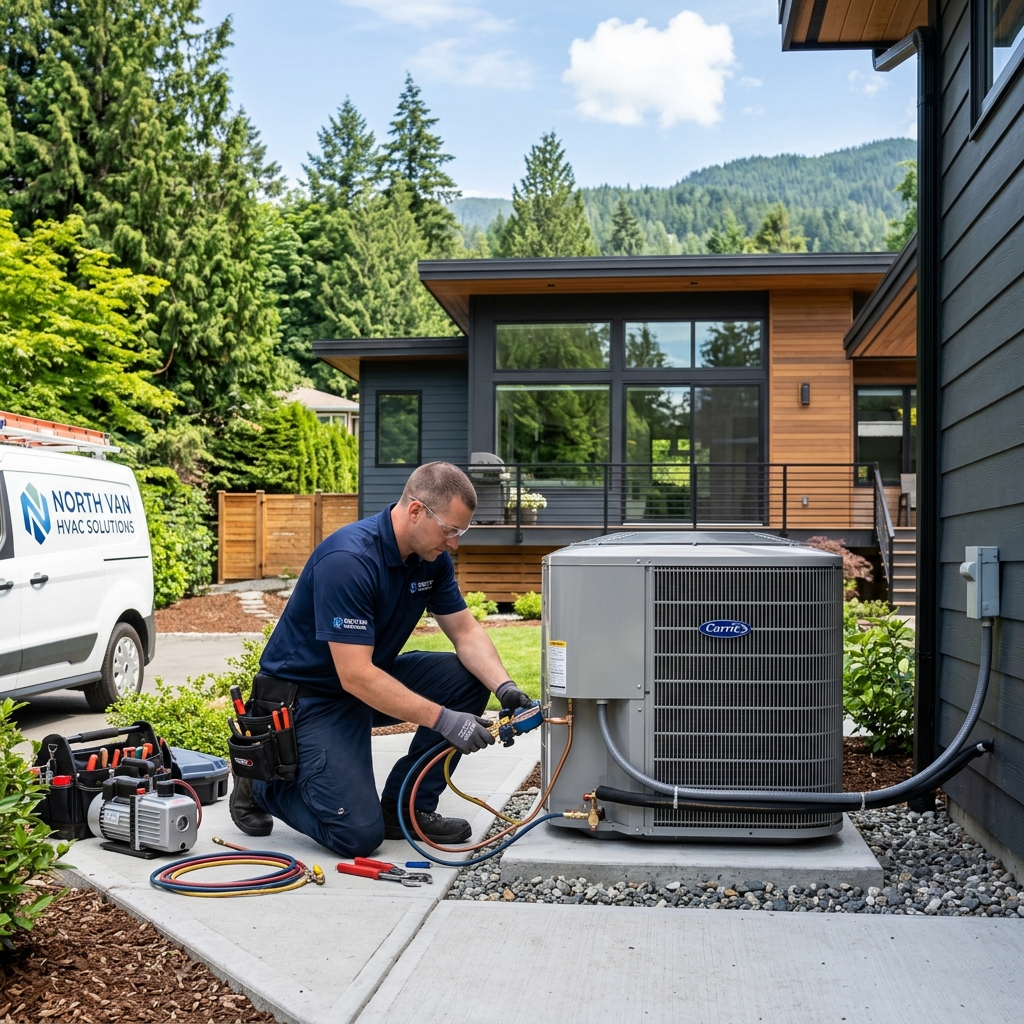
Central AC uses your existing furnace ductwork to distribute cooled air throughout the home. A condenser unit sits outside, connected to an evaporator coil mounted on your furnace or air handler. This is the most cost-effective option if your home already has ductwork in good condition.
Ductless Mini-Split Systems
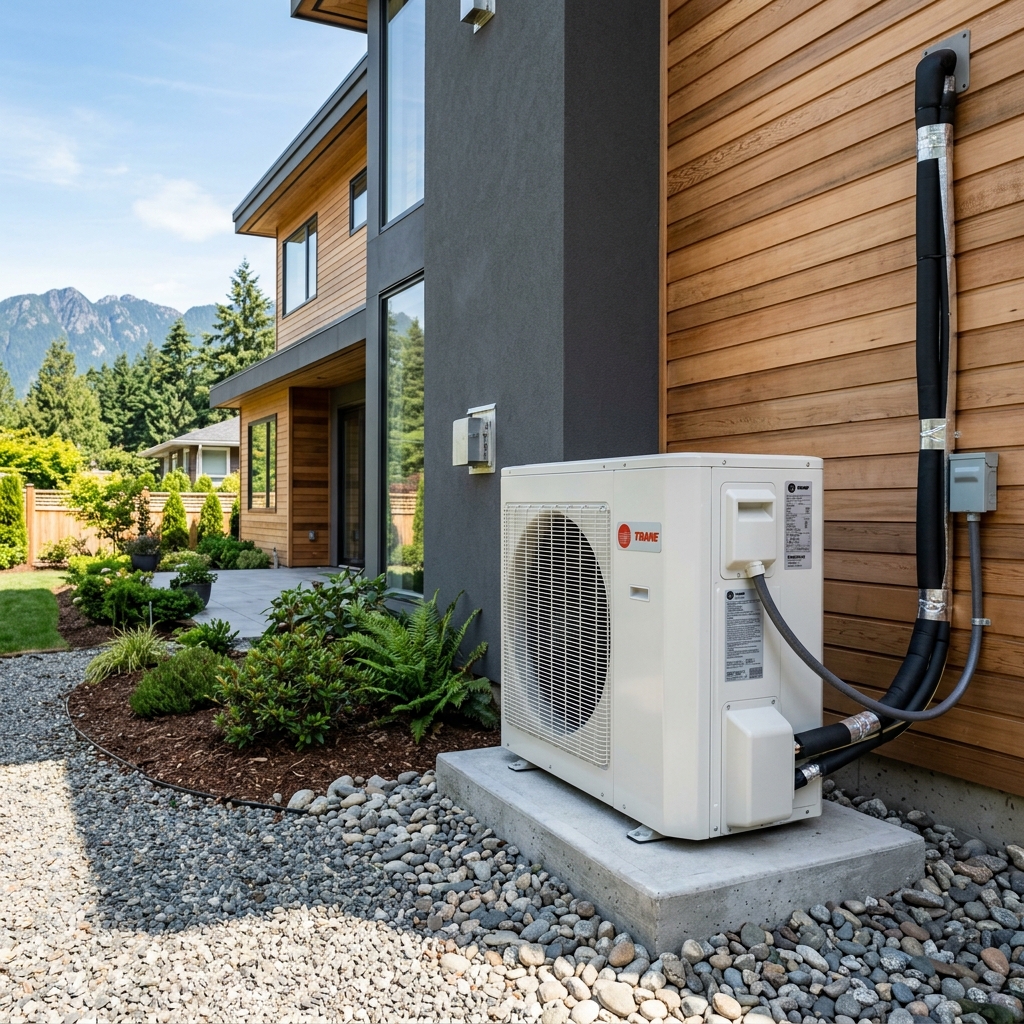
Ductless mini-splits are ideal for homes without existing ductwork—which includes many older North Vancouver homes. A small outdoor compressor connects to one or more wall-mounted indoor units via refrigerant lines. Each indoor unit can be independently controlled, providing zone-by-zone temperature control.
Heat Pump Systems
A heat pump is essentially an AC system that can reverse direction to provide heating in winter. For North Vancouver homeowners, this is almost always the best choice because you get both cooling and heating from a single investment. Heat pumps come in both ducted and ductless configurations.
Portable and Window Units
While these are the cheapest upfront option ($200-$600), they're noisy, inefficient, and only cool one room at a time. They're fine as a temporary solution, but we don't recommend them as a permanent cooling strategy for any North Shore home.
Proper Sizing for North Shore Homes
Proper sizing is the single most important factor in AC performance. An undersized system won't cool adequately on the hottest days. An oversized system short-cycles (turns on and off rapidly), leading to poor humidity control, uneven temperatures, and premature equipment failure.
Professional sizing involves a Manual J load calculation that considers:
- Square footage of conditioned space
- Insulation levels in walls, attic, and crawlspace
- Window area, type, and orientation (south and west-facing windows add significant heat)
- Number of occupants and internal heat sources
- Air infiltration rate (how leaky the building envelope is)
- Shading from trees and neighbouring buildings
General guidelines for North Vancouver:
- 1,200-1,800 sq ft home: 1.5-2.5 tons
- 1,800-2,500 sq ft home: 2.5-3.5 tons
- 2,500-3,500 sq ft home: 3.5-5.0 tons
North Shore homes with large south-facing windows overlooking the harbour, or those at higher elevations in British Properties or Capilano Highlands, may need upsizing due to increased solar gain. Conversely, heavily shaded homes in Deep Cove or the forested areas of Lynn Valley may need less capacity.
Installation Costs in North Vancouver
Here's what to budget for AC installation on the North Shore:
- Central AC (with existing ductwork): $4,500 – $8,000
- Ductless mini-split (single zone): $3,500 – $5,500
- Ductless mini-split (multi-zone, 2-3 heads): $7,000 – $14,000
- Ducted heat pump (heating + cooling): $10,000 – $18,000 before rebates
- Ductless heat pump (heating + cooling): $4,000 – $8,000 per zone before rebates
Remember that heat pump installations qualify for up to $16,000 in BC rebates, dramatically reducing the effective cost. A $15,000 ducted heat pump installation might cost only $3,000-$5,000 out of pocket after rebates—less than a standalone AC unit with no rebate eligibility.
Permits & Regulations
Both the District of North Vancouver and City of North Vancouver require building permits for AC installations that include:
- New refrigerant line installations
- Electrical panel upgrades or new dedicated circuits
- Structural modifications for ductwork
- Exterior condenser unit placement (setback requirements apply)
The District of North Vancouver requires outdoor condenser units to be placed at least 1 metre from property lines and may have noise bylaws affecting placement near neighbouring homes. In some areas of West Vancouver, additional aesthetic guidelines apply.
At Lord Mechanical, we handle all permit applications, inspections, and compliance as part of our installation service. You don't need to navigate municipal red tape—we do it for you.
Heat Pump vs Standalone AC: Our Recommendation
For almost every North Vancouver homeowner, we recommend a heat pump over a standalone AC unit. Here's why:
- Dual purpose: A heat pump provides both cooling AND heating, eliminating the need for a separate furnace.
- Massive rebates: Heat pumps qualify for up to $16,000 in government incentives. Standalone AC units qualify for little or nothing.
- Lower operating costs: Heat pumps in cooling mode are just as efficient as AC units. In heating mode, they're 2-4x more efficient than gas furnaces.
- Future-proofing: BC is moving toward banning new gas appliances in residential buildings. A heat pump positions your home for future regulations.
- Increased home value: Buyers are actively seeking homes with heat pumps, especially in competitive North Shore markets.
Best Time to Install
Spring (March-May) is the ideal time to install air conditioning or a heat pump in North Vancouver. Demand is lower than during heat waves, so scheduling is easier, lead times are shorter, and you'll be ready before the first hot day. Waiting until July or August means competing with panicking homeowners for limited contractor availability.
That said, we install year-round. If you're reading this in December, now is actually a great time to plan and book your spring installation while availability is wide open.
Choosing the Right Contractor
Not all HVAC contractors are created equal. When choosing an installer for your North Vancouver AC or heat pump, verify:
- Licensing: Must hold a valid BC HVAC and refrigeration mechanic certificate
- Insurance: Comprehensive general liability and WorkSafeBC coverage
- Rebate registration: Must be a registered CleanBC contractor if you want rebates
- Local experience: Familiarity with North Shore homes, building codes, and permit processes
- Reviews: Check Google reviews—look for consistency, not just star ratings
- Warranty: Both equipment warranty and labour warranty on the installation
Lord Mechanical LTD is a licensed, bonded, and insured contractor with a 5-star Google rating across 100+ reviews. We've been installing heating and cooling systems on the North Shore since 2009 and know these homes inside and out.
Frequently Asked Questions