
British Columbia sits on one of the most seismically active regions in North America. The Cascadia Subduction Zone, running along the coast from Vancouver Island to Northern California, is capable of producing a magnitude 9.0+ earthquake — and seismologists estimate there's a 37% chance of a significant quake occurring within the next 50 years.
While most earthquake preparedness advice focuses on supplies, structural retrofitting, and personal safety, few people think about their plumbing system. Yet plumbing failures are among the most dangerous and costly consequences of earthquakes. Ruptured gas lines cause fires. Broken water mains flood basements. Damaged sewer lines create health hazards. And a toppled water heater can do all three simultaneously.
The good news? Most plumbing earthquake damage is preventable with relatively simple, affordable upgrades that any licensed plumber can install.
Understanding BC's Earthquake Risk
The Lower Mainland faces seismic risk from three sources:
1. Cascadia Subduction Zone: The "Big One" — a magnitude 8.0–9.2 mega-thrust earthquake that occurs roughly every 200–500 years. The last one struck in 1700. We are statistically within the window for the next event.
2. Shallow Crustal Earthquakes: Smaller but more frequent earthquakes (magnitude 5.0–7.0) originating from fault lines directly beneath the Lower Mainland. These are closer to the surface and can cause significant local damage despite lower magnitude.
3. Deep Intraslab Earthquakes: Moderate earthquakes occurring within the subducting oceanic plate at depths of 30–60 km. The 2001 Nisqually earthquake near Seattle (6.8 magnitude) was this type.
North Vancouver's geology adds another risk factor: many homes are built on slopes with varied soil composition. Loose or saturated soil amplifies seismic waves, and the steep terrain of the North Shore creates potential for secondary effects like landslides that can rupture buried water and sewer lines.
How Earthquakes Damage Your Plumbing
Gas Line Ruptures
Rigid gas connections — particularly old black iron pipe connections to appliances — can crack during seismic shaking. Even a small gas leak in an enclosed space creates explosion risk. This is the most dangerous plumbing-related earthquake consequence.
Water Heater Toppling
An unstrapped water heater can tip during moderate shaking, snapping its water supply lines, gas connection, and flue vent. A 50-gallon tank weighs over 400 pounds when full. When it falls, it can rupture the gas line (fire risk), flood your utility room (water damage), and block your evacuation route.
Pipe Joint Failures
The differential movement between your home's structure and the ground can stress pipe joints, particularly where pipes pass through foundation walls. Rigid piping materials (cast iron, galvanized steel) are more vulnerable than flexible materials (PEX, copper with properly soldered joints).
Sewer Line Breaks
Underground sewer lines — especially older clay or concrete pipes — can crack, separate, or collapse from ground movement. Sewer line damage may not be immediately obvious but can contaminate groundwater and create health hazards.
7 Plumbing Protection Measures Every BC Home Needs
1. Strap Your Water Heater (Essential — $100–$250)
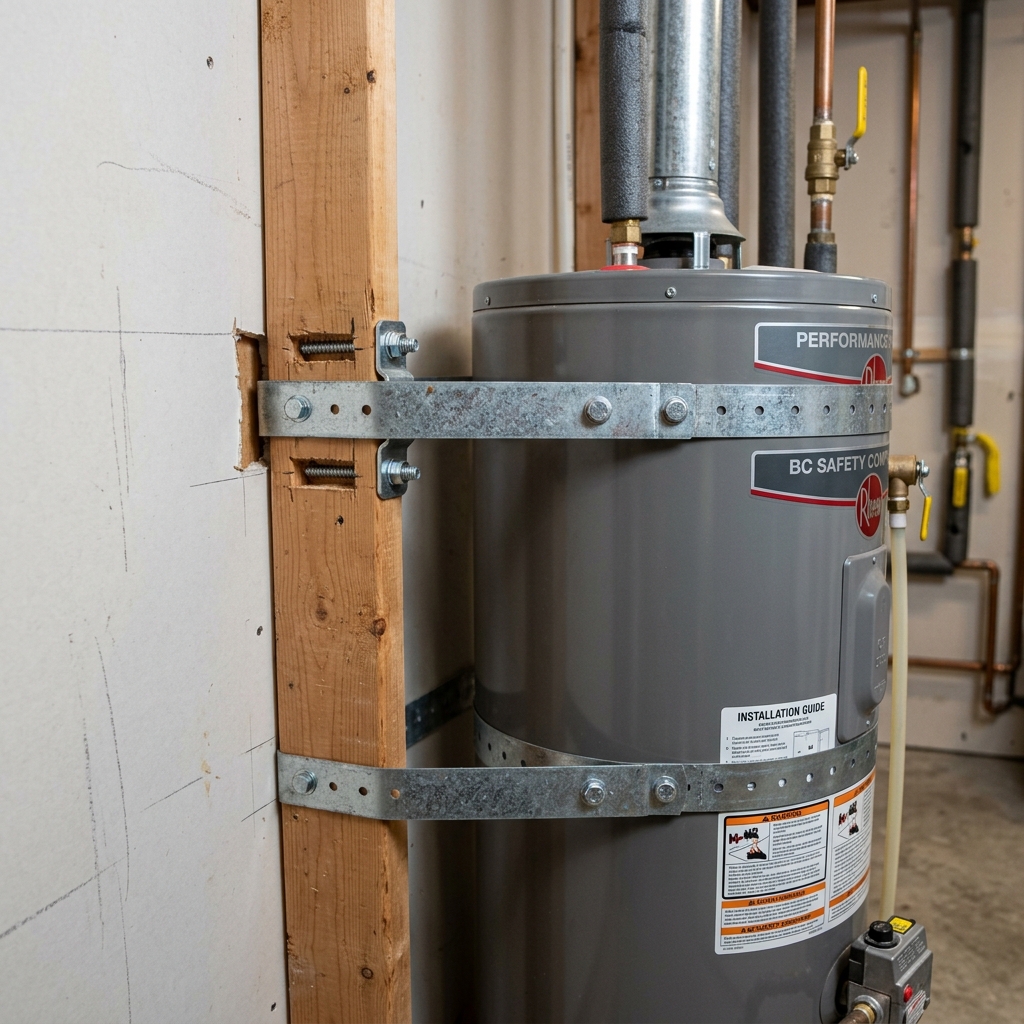
Seismic strapping is the single most important plumbing earthquake upgrade. Two heavy-duty metal straps — one at the top third and one at the bottom third of the tank — anchor the water heater to the wall studs. BC Building Code requires seismic strapping on all water heaters. If yours isn't strapped, schedule this immediately.
2. Install an Automatic Earthquake Gas Shutoff Valve ($300–$600)
These remarkable devices detect seismic vibrations above a threshold (typically equivalent to magnitude 5.0+ at your location) and automatically close the main gas supply within seconds. They require no electricity, no batteries, and no human action. After the earthquake, a qualified technician resets the valve once the gas system has been inspected. This is the most effective way to prevent post-earthquake gas fires.
3. Use Flexible Gas Connectors (Essential — $50–$150 per appliance)
Every gas appliance in your home — water heater, furnace, stove, dryer, fireplace — should be connected with CSA-approved flexible corrugated stainless steel connectors. These allow the appliance to shift up to several inches during shaking without rupturing the gas line. Replacing a rigid connection costs $50–$150 per appliance and takes about 30 minutes each.
4. Know Your Shutoff Valve Locations
Every household member should know the location of:
- Main water shutoff: Usually at the water meter (front of property) or where the main line enters the house
- Gas shutoff: At the gas meter, using a 12" adjustable wrench (keep one strapped to the meter)
- Individual fixture shutoffs: Under sinks, behind toilets, at the water heater
Label these valves clearly. Practice turning them off and on. In an earthquake, you may need to act quickly in the dark.
5. Replace Rigid Pipe Connections Through Foundation Walls ($200–$500)
Where water and sewer lines penetrate your foundation, the rigid connection between moving ground and building structure creates a stress point. Flexible couplings or braided stainless steel connections at these penetrations allow independent movement without breakage.
6. Install a Whole-House Water Shutoff Valve ($400–$800)
An accessible, easy-to-operate ball valve on your main water line near where it enters the house lets you quickly stop all water flow. If your current shutoff is a corroded gate valve that barely turns, replace it with a modern quarter-turn ball valve. This is also smart for general plumbing — not just earthquake preparedness.
7. Secure Heavy Plumbing Fixtures ($100–$300)
Tankless water heaters, wall-mounted boilers, expansion tanks, and HVAC equipment should all be securely fastened to structural elements. Verify that mounting brackets are rated for seismic loads, not just dead weight.
What to Do After an Earthquake: Plumbing Steps
After the shaking stops and you've ensured your family's safety:
- Check for gas leaks FIRST. If you smell gas, hear hissing, or see damage to gas lines, leave the building immediately. Do not use light switches, phones, or anything that could create a spark. Call 911 and FortisBC from outside.
- Shut off the main gas supply at the meter if you have any doubt about gas line integrity. Use the wrench you've kept strapped to the meter.
- Check for water leaks. Inspect visible pipes, the water heater, under sinks, and in the basement. If you find leaks or hear water running in walls, shut off the main water supply.
- Do NOT flush toilets until you've confirmed the sewer line is intact. Check your cleanout for backflow and look for sunken ground over the sewer line route.
- Check the water heater. If it has shifted, is leaking, or if gas connections appear damaged, shut off its gas and water supply valves.
- Document damage with photos for insurance purposes before making repairs.
- Call a licensed plumber for professional assessment before using your plumbing system if you found any damage. Lord Mechanical provides emergency plumbing services for post-earthquake assessment and repair.
Emergency Water Supply from Your Plumbing
After a major earthquake, municipal water may be unavailable for days or weeks. Your plumbing system contains usable emergency water:
- Water heater tank: A 50-gallon tank holds 190 litres of drinkable water. Use the drain valve at the bottom of the tank. Turn off the gas/electricity to the unit first.
- Toilet tanks (not bowls): The water in toilet tanks is clean supply water and can be used for drinking if needed (not if you use tank-cleaning chemicals).
- Pipes: Open the highest faucet in the house, then drain water from the lowest faucet. Gravity will drain water from the pipe system.
This emergency supply can sustain a family for several days. Of course, stored water (1 gallon per person per day, minimum 72-hour supply) is the ideal preparation.