
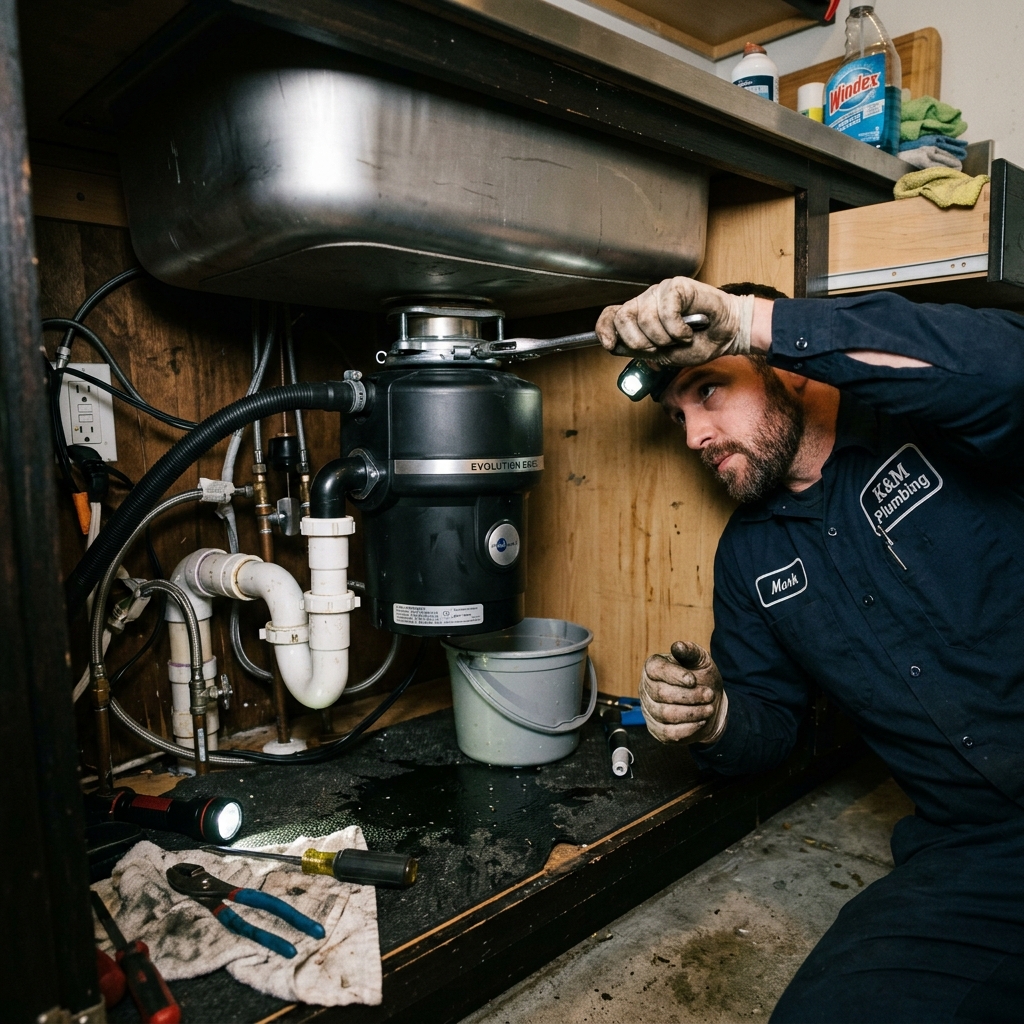
Your garbage disposal grinds reliably every day — until it doesn't. Whether it's humming ominously, leaking under the sink, refusing to turn on, or producing a smell that could clear a room, garbage disposal problems are one of the most common calls we receive at Lord Mechanical.
The good news? Many garbage disposal issues have simple fixes that homeowners can handle themselves. The better news? When you do need a professional, garbage disposal repair is one of the more affordable plumbing services. Here's your complete troubleshooting guide.
How Garbage Disposals Work
Before troubleshooting, it helps to understand what's happening inside that metal canister under your sink. Contrary to popular belief, garbage disposals don't have sharp blades that cut food like a blender. Instead, they use a spinning disc (called an impeller plate) with two small lugs that force food waste against a stationary grind ring. The centrifugal force and the textured ring break food down into tiny particles that wash down the drain.
The motor that spins the impeller plate is typically 1/3 to 1 horsepower. When the motor can't spin — because something is jammed between the impellers and the grind ring — you get that distinctive humming sound. And when the motor overheats from trying to push through a jam, the thermal overload switch trips, and the unit goes completely silent.
Understanding this mechanism explains why certain foods cause problems: fibrous materials wrap around the impellers, hard objects jam between the impellers and grind ring, and starchy foods create a paste that clogs the drain below the disposal.
7 Common Garbage Disposal Problems
1. Disposal Hums But Won't Spin
This is the most common issue and almost always means something is jammed between the impellers and the grind ring. The motor is getting power (hence the hum) but can't rotate. If left humming too long, the motor will overheat and trip the reset button.
2. Disposal Won't Turn On At All
Complete silence when you flip the switch could mean: the reset button has tripped, a breaker has tripped, the switch itself has failed, or the motor has burned out. Check the simple things first — the reset button is on the bottom of the unit.
3. Disposal Leaks From the Bottom
A leak from the bottom of the disposal body (not the connections) usually means the internal seals have failed. This is age-related and generally means it's time for replacement rather than repair. Leaks from the mounting flange or discharge pipe connections can usually be fixed by tightening or replacing gaskets.
4. Slow Draining After Grinding
If the disposal grinds food but the water drains slowly, the issue is likely a partial clog in the drain pipe downstream of the disposal. This is often caused by grease buildup, fibrous food residue, or insufficient water flow during grinding.
5. Persistent Bad Odors
Food residue accumulates on the underside of the splash guard, on the impeller plate, and inside the grind chamber. Over time, bacteria colonize these deposits and produce that distinctive rotten-food smell. Regular cleaning eliminates this problem entirely.
6. Disposal Makes Grinding or Rattling Noises
Unusual metallic grinding or rattling sounds often indicate a foreign object has fallen into the disposal — a spoon, fork, bottle cap, or piece of glass. Turn the disposal off immediately. These objects can damage the impellers and grind ring if not removed.
7. Disposal Needs Frequent Resetting
If you're pressing the reset button more than once a month, the disposal is overheating repeatedly. This usually indicates a failing motor, worn grinding components that require more effort to process food, or consistent overloading. A disposal in this condition is nearing end-of-life.
DIY Fixes You Can Try Safely
Unjamming a Stuck Disposal
Safety first: Always turn off power before putting anything into the disposal. Turn off the wall switch AND unplug the unit (or flip the breaker) before proceeding.
- Insert the hex wrench (Allen key) into the hole at the bottom center of the disposal unit. Most disposals use a 1/4-inch hex key.
- Turn the wrench back and forth — you're manually rotating the impeller plate to free whatever is jammed.
- Once the wrench turns freely, use tongs or pliers (never your fingers) to remove the jammed object from above.
- Press the reset button on the bottom of the unit.
- Turn the power back on and test with running cold water.
Resetting a Tripped Disposal
The reset button is a small red or black button on the bottom of the disposal. If it's popped out, the thermal overload has tripped. Wait 5 minutes for the motor to cool, press the button firmly until it clicks and stays in, then try the switch again.
Clearing a Slow Drain Below the Disposal
Disconnect the discharge pipe from the disposal (bucket underneath to catch water). Clear any visible blockage. If the clog is further downstream, a standard drain snake can be fed through the pipe. Reconnect and test. For persistent drain issues, consider our professional drain cleaning services.
Eliminating Odors
Try these methods, in order of intensity:
- Ice and salt: Drop a handful of ice cubes and a tablespoon of coarse salt into the disposal. Run it with cold water for 30 seconds. The ice and salt scour the grinding chamber.
- Baking soda and vinegar: Pour 1/2 cup baking soda followed by 1 cup white vinegar. Let it fizz for 10 minutes, then flush with hot water while running the disposal.
- Citrus peels: Grind lemon or orange peels to leave a fresh scent and clean the chamber with natural citric acid.
- Clean the splash guard: Pull the rubber splash guard up and scrub the underside with a brush and dish soap. This is where most odor-causing buildup hides.
When to Call a Plumber
While many disposal issues are DIY-friendly, certain situations require a licensed plumber:
- Water leaking from the disposal body (not connections) — internal seal failure requires replacement
- The disposal won't turn on after reset and breaker check — possible wiring issue or motor failure
- Persistent drain clogs downstream of the disposal — may indicate a deeper sewer line issue
- Electrical problems — any burning smell, sparks, or tripped GFCI outlets need professional attention
- You need a new disposal installed — especially if upgrading size or connecting to a dishwasher drain
Repair vs. Replace: Making the Right Call
Repair when:
- The unit is less than 8 years old
- The problem is a simple jam or tripped reset
- Leaks are coming from connections (flange, discharge pipe) rather than the body
- A foreign object caused a one-time jam
Replace when:
- The unit is leaking from the body
- The motor has burnt out
- You're resetting it frequently (more than once a month)
- It's older than 10–12 years
- You want to upgrade to a more powerful or quieter model
Replacement Cost Guide
- Basic disposal (1/3 HP) $300 – $400 installed
- Mid-range (1/2 HP, insulated) $400 – $600 installed
- Premium (3/4–1 HP, ultra-quiet) $600 – $900 installed
Preventing Future Garbage Disposal Problems
Follow these habits and your disposal will serve you reliably for years:
- Always run cold water before, during, and for 15 seconds after grinding. Cold water solidifies grease so it gets ground up rather than coating pipes.
- Feed food gradually — don't dump a plate of scraps all at once. Small amounts allow the disposal to grind efficiently.
- Never pour grease down the disposal — it coats everything and eventually solidifies into a clog.
- Avoid fibrous foods: Celery, artichokes, corn husks, onion skins, and asparagus wrap around impellers.
- Clean monthly with ice, salt, and citrus peels. Clean the splash guard biweekly.
- Run it regularly — even if you don't have food to grind, running the disposal with water prevents rust and keeps parts moving freely.
If you're planning a kitchen renovation, it's the perfect time to upgrade your disposal. Modern units are significantly quieter, more powerful, and more energy-efficient than models from even 5 years ago.