

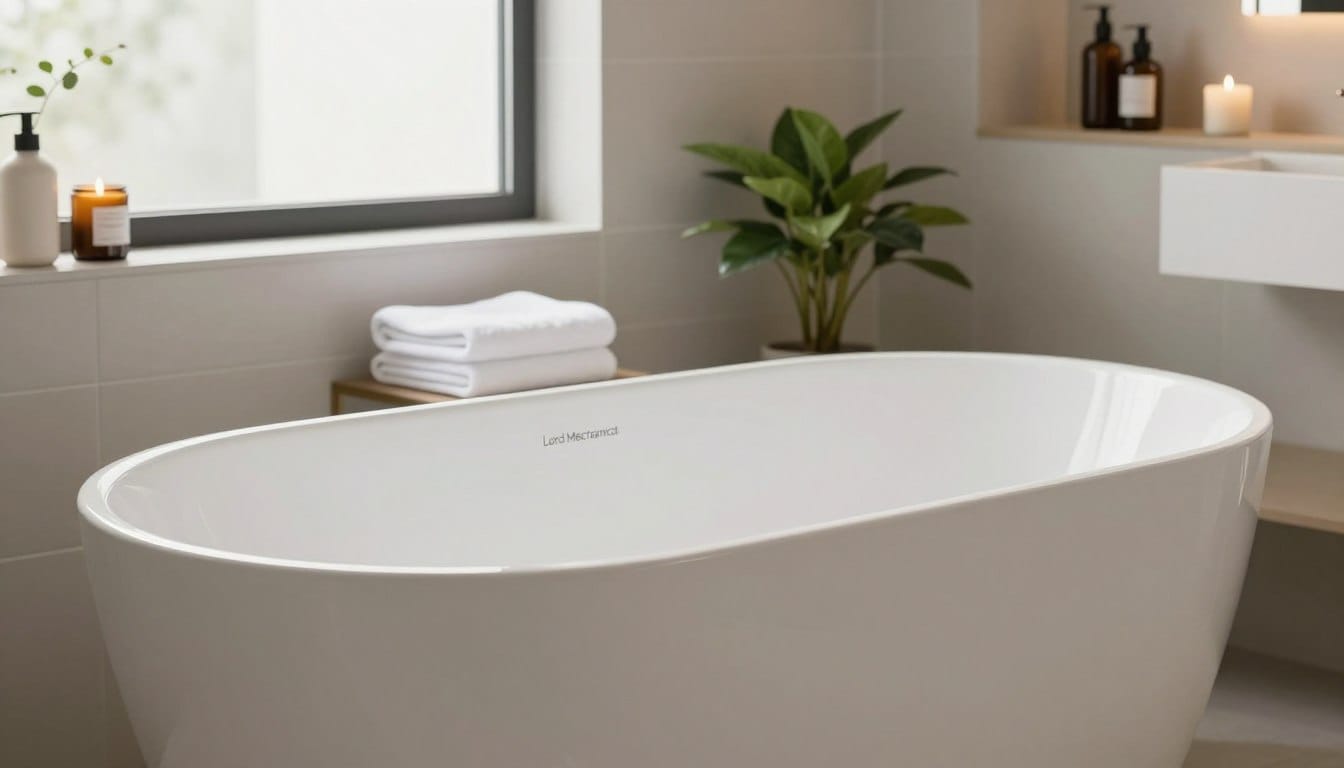
Did you know the average all-in bathtub installation costs about $2,110 in North America? That figure frames how we approach every remodel in North and West Vancouver.
We explain how to choose a tub that fits your space, lifestyle and the real-world quirks of older Vancouver homes. Expect walls and floors that are not perfectly square and drains that rarely sit where plans say they will.
Our approach treats the installation as a clear sequence: measure rough-in, pick style and material, set budget, prep safely, remove the old unit, rebuild as needed, then connect drains and seal to avoid leaks.
We draw on jobsite experience at Lord Mechanical LTD to show what “straightforward replacement” really means and to flag common surprises like subfloor rot and outdated plumbing. Call us at 6046703737 to discuss your bathroom project.
Key Takeaways
- Average all-in cost is roughly $2,110 — plan accordingly.
- Measure and verify rough-in and drain placement before ordering.
- Even same-size swaps can change once framing and floors are assessed.
- Material choice affects comfort, heat retention and maintenance.
- Common hidden issues: subfloor rot, old pipes and misaligned drains.
- We offer practical, jobsite-tested advice for Vancouver homeowners.
Measure your bathroom space and confirm the plumbing rough-in
Accurate site measurements and a verified rough-in prevent surprises when the new tub arrives. We measure alcove width, length and depth against the rough framing so you buy a unit that fits the real space.
Use the manufacturer’s rough-in submittal to confirm the drain centreline, overflow height and overall dimensions before you commit. This step shows whether the plumbing aligns with the tub and flags offset traps or joist conflicts early.
Quick checks to make
- Measure alcove width/length/depth and note stud locations.
- Verify drain position and access for waste/overflow connections.
- Confirm the floor area is level and slopes correctly for proper drainage.
| Measure | Tolerance | Action if out of spec |
|---|---|---|
| Alcove width/length | ±3 mm | Adjust framing or select alternate tub |
| Drain centreline | ±10 mm | Use flexible waste or relocate before setting |
| Floor level / slope | Level ±2 mm per 600 mm | Shim, add mortar bed or correct subfloor |
Rough-in confirmation means checking studs, clearances and service access so you can maintain the drain and waste later. When a fit is tight, pause and reframe — forcing a tub often causes flange stress and future leaks.
Questions? Call Lord Mechanical LTD at 6046703737 for local guidance in North and West Vancouver.
Select a bathtub style that fits your home and bathroom layout
Pick a style that matches how you use the room and the plumbing already in place. We weigh everyday use, space limits in North and West Vancouver homes, and the plumbing moves you want to avoid.
Alcove tubs work best for tub-shower combos and straightforward swaps. They fit existing openings, keep fixtures in the same place, and tend to be the quickest option to replace.
Freestanding options
Freestanding tubs change the look and the plumbing. Expect visible supply lines or floor-based connections and different drain routing. Plan the finished look early and budget for specialty plumbing.
Soaking, walk-in and jetted tubs
Deeper soaking tubs and walk-in models raise hot-water demand and often extend the installation process. Jetted tubs usually need space for equipment and a dedicated electrical circuit. Account for service access and timeline when you choose a model.
- Cost ranges (materials excluded): all-purpose $200–$800; freestanding $2,500–$10,000; jetted $1,000–$4,000; soaking $600–$13,000; walk-in $2,000–$8,000.
- We help you pick between alcove, freestanding, soaking, walk-in and jetted tubs based on how your bathroom is built and how you use the space.
- Questions about the best place for a new tub in your Vancouver home? Call Lord Mechanical LTD at 6046703737 for practical advice.
Choose the right tub material for durability, comfort, and install complexity
Material matters. It shapes warmth, sound, surface life and whether your floor needs reinforcement for the project.
Common, budget-friendly options
Fiberglass ($200–$800) and enameled steel ($200–$1,000) are light and easy to handle. Acrylic ($700–$1,000) feels warmer under skin and resists chips better than basic fiberglass.
Premium materials and trade-offs
Cast iron ($400–$14,000), copper ($2,000–$5,000) and solid surface ($2,100–$8,000) offer superior heat retention and visual impact.
Stone options like granite ($10,000–$20,000) or cultured marble ($2,000–$5,000) are dramatic but very heavy.
When weight requires reinforcement
Heavy tubs can overload joists. Adding joists or a supporting beam protects the subfloor and prevents movement that leads to grout cracks and water damage.
- Light materials reduce labour and often lower the cost of a simple replacement.
- Heavy materials may suit a full remodel with planned structural upgrades.
Questions about the right choice for North or West Vancouver? Call Lord Mechanical LTD at 6046703737 for local advice.
Plan your budget, timeline, and scope for a bathtub replacement in Canada
Start with a clear project brief so you know costs, trade access and how long the work will keep your bathroom out of service. We use a Canada-focused budget frame and local jobsite experience to set realistic expectations for North and West Vancouver.
Typical all‑in pricing averages about $2,110 (Homewyse). That often covers the tub, drain/overflow, basic plumbing connection and removal of the old unit. Demolition and disposal typically add $200–$1,200.
Cost drivers and timeline
Major drivers include surrounds (acrylic $300–$700; tile $120–$6,000; natural stone $2,400–$24,000), labour ($100–$2,000), plumber hourly rates ($45–$200/hr), and permits ($50–$500).
“Keeping the layout saves time and money — moving drains or valves increases trades and permit needs.”
| Item | Typical range (CAD) | Notes |
|---|---|---|
| Average all‑in | $2,110 | Baseline for simple swaps |
| Demolition & disposal | $200–$1,200 | Access and disposal fees affect cost |
| Permits & plumbing labour | $50–$500 / $45–$200/hr | Permits required for major changes |
Hidden costs to watch
After removal you may find water damage behind tub walls or a compromised subfloor that needs repair. Structural, plumbing or carpentry fixes can turn a 6‑hour swap into a week‑long project.
Get itemized quotes and sequence work (demo, subfloor repair, framing, plumbing test, finishes) to reduce downtime. Call Lord Mechanical LTD at 6046703737 for local guidance and accurate quotes in North and West Vancouver.
Gather tools, parts, and safety prep before installation day
We prepare methodically. Before work begins, gather the parts and tools you need. Lay them in a clear place so trades don’t waste time hunting fittings or fasteners.
Turn off supply and confirm shut-offs
Turn off the main water supply and operate each shut-off. Confirm they hold under pressure. Failed shut-offs cause emergency water damage during remodels.
Inspect for early signs of leaks
Check the alcove and nearby finishes for musty smells, warped walls or staining on ceilings and floors. Repair any prior damage before covering it up.
Dry-fit the tub and check wall plumbness
Dry-fit the tub to test clearances and reveal framing issues. Verify walls are plumb and the place allows proper sealing. Forcing an out-of-square unit creates gaps that are hard to waterproof.
| Check | What to look for | Action |
|---|---|---|
| Water shut-offs | Hold under pressure | Replace or service before work |
| Leak indicators | Musty odour, stains, warp | Repair framing or drywall |
| Dry-fit | Clearances & plumb walls | Adjust framing or choose alternate |
| Parts on hand | Fittings, screws, sealant | Stage in work area |
Next step: With prep complete, you cut risk and shorten the work time. Call Lord Mechanical LTD at 6046703737 for local help in North and West Vancouver.
Demolition and subfloor prep to prevent movement and water damage
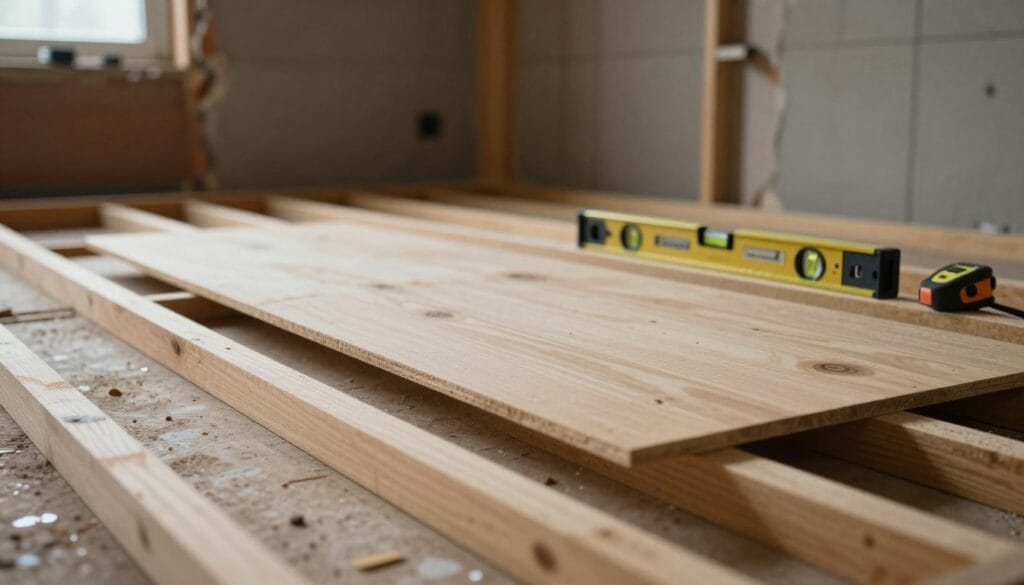
Careful demolition is the first step in a controlled process that prevents future movement and water damage. We open up the space to find hidden problems and fix them before the new tub goes in.
Remove the old unit without harming pipes and lines
Pull the old unit and surround with a hammer and super bar. Remove or pound nails back into the joists so loose fasteners don’t later puncture pipes.
Repair patchwork floors and restore a stable base
Where the floor is pieced together, we cut out weak sections and install 3/4″ plywood into joists. Apply construction adhesive (eg. Liquid Nails) to reduce flex and squeaks.
Fastening best practices and when to add a second layer
Hit joists, not thin air. Mark waste pipe rough locations before screwing to avoid puncturing drains or electrical runs. If the base still feels soft, add a 1/2″ second layer with more adhesive for a true level surface.
- Quick steps: demo carefully, clear fasteners, mark pipes, glue joists, fasten plywood into joists.
- Why this matters: a solid subfloor keeps seals tight and reduces the chance of water damage later.
Questions about a Vancouver job? Call Lord Mechanical LTD at 6046703737 for local advice in North and West Vancouver.
Frame and reinforce the alcove walls, studs, and support ledgers
A straight, plumb alcove makes every subsequent step—sealing, finishing and servicing—simpler and more reliable.
We dry-fit the unit, mark the true opening, then add or plumb new studs to those marks. Proper spacing keeps the wall substrate supported when you fit waterproof boards or tile backer.
Stud layout matters. We set studs at 16 inches on-centre where the wall system calls for it. That spacing gives a secure place to fasten boards and stops flex that leads to cracked grout and failed seals.
Stringers or support ledgers sit behind the tub flange so the weight rests on framing, not on fasteners. Where gaps exist we shim and level to close the void and avoid flange stress during long-term use.
Fastening tips: use corrosion-resistant screws and pre-drill brittle flanges per the manufacturer guidance. That reduces cracking and keeps the finished seam tight.
| Task | Spec | Benefit |
|---|---|---|
| Stud spacing | 16 in. on-centre | Solid backing for boards and tiles |
| Support ledger | Full-length stringer behind flange | Transfers load to framing, reduces flex |
| Shims & leveling | Fine-adjust until level | Prevents future cracks and leaks |
Questions about framing or local code in North or West Vancouver? Call Lord Mechanical LTD at 6046703737 for practical, jobsite-tested guidance.
Bathtub installation: drain, waste, and overflow connections done right
Getting the drain and waste system correct is one of the most important steps in the project. Small mistakes here often turn into hidden leaks behind tub walls. We follow a simple, repeatable process so connections stay watertight and accessible for service.
Mark and cut for reliable access
Dry-fit the unit and mark the drain position precisely. Cut an elliptical opening in the subfloor for access, keeping the cut small enough to preserve floor strength but large enough to reach fittings.
Assemble the waste and overflow before securing the unit
Build the waste and overflow assembly on the bench when possible, then fit it to the tub flange before final fastening to studs. This saves time in tight alcoves and reduces the risk of straining pipes or cracking the overflow bracket.
Seal gaskets with a continuous bead of silicone
Use 100% silicone at every gasket-to-tub contact: overflow gaskets, tub shoe and drain flange. Apply a continuous bead silicone line where parts meet the shell to reduce leaks. A neat bead applied evenly gives a durable seal and easier inspection later.
Flexible kits and final testing
When rough-ins are offset or joists obstruct access, flexible bath waste kits — for example, Dearborn® True Blue® FLEX — let us route the waste without extra fittings. These kits save time and reduce joint counts in the pipes.
Connect to the P-trap, pressurize the system with water, and inspect every connection point for leaks. Keep PVC primer off finished surfaces to avoid cosmetic damage. Test thoroughly before closing walls.
| Step | Action | Why it matters |
|---|---|---|
| Mark & cut | Dry-fit, mark drain, cut elliptical access | Provides service access without weakening floor |
| Pre-assemble waste | Fit waste/overflow to tub before fastening | Improves access and reduces stress on fittings |
| Silicone sealing | Apply continuous bead of 100% silicone at gaskets | Prevents leaks where parts meet the shell |
| Flexible waste | Use flex kits for offset drains or tight spots | Reduces extra fittings and simplifies routing |
| Pressure test | Fill and inspect all joints under water pressure | Confirms watertight connections before finishing |
Questions on drain or waste work in North or West Vancouver? Call Lord Mechanical LTD at 6046703737 for jobsite-tested advice and local plumbing support.
Set the tub solidly, level it precisely, and secure it to the studs
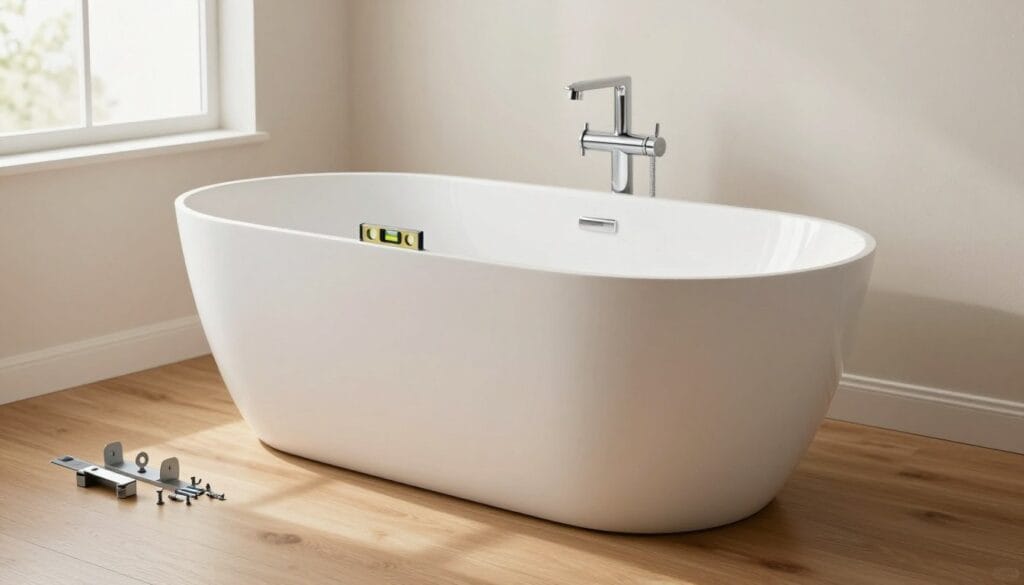
We place the tub on a firm mortar pad, check the tub level on every edge, then fasten the flange to the studs. This simple sequence reduces movement and protects finishes over time.
Mortar bed support to reduce flex
Use a supportive mix such as Mapei 4-to-1 Mud Bed Mix. Mix to a stiff, non-runny consistency and lay about 2 inches thick under the tub base.
Keep mortar a few inches back from the drain opening so water access is not blocked. Press the tub into the bed to form full contact under the shell.
Check levels on multiple edges
Verify level across the long and short edges. Use a 4-foot level and check diagonals too. Adjust while the mortar is workable so water flows to the drain and no pooling occurs.
Fasten the flange correctly
Pre-drill the flange to align holes with studs and use corrosion-resistant screws. Shim behind the flange where gaps exist so screws don’t pull the lip tight and crack the shell.
- Why it matters: a solid bed, correct tub level and proper flange fastening stop flex, cracked caulk and slow leaks.
- Coordinate this process with your plumber and finishing trades for a smooth installation.
Questions about best practices in North or West Vancouver? Call Lord Mechanical LTD at 6046703737 for local, jobsite-tested advice.
Finish the walls and seal everything to stop leaks behind the tub
Correct wall finishing and seals are the final defence against leaks and hidden damage. We treat this step as structural protection, not just cosmetics. A small miss here invites mould and costly water damage.
Choose the correct wallboard for tile vs. acrylic surrounds
For tile, use an approved cement backer or water‑resistant sheathing. For acrylic surrounds, follow the manufacturer’s wall backing guide.
Proper wall choice controls moisture movement and protects framing and fixtures.
Apply a continuous bead of silicone or caulk at joints
Seal change-of-plane joints, tub-to-wall seams and any penetrations. Apply a continuous bead of silicone where flexibility is critical and use a quality caulk where paintability is needed. Tool the bead smooth and allow full cure before wetting.
Protect the tub surface during other trades
Use a dedicated tub protector or corrugated cardboard and soft barriers while tile, paint or trim work progresses. This prevents scratches, stains and dents that lead to later repairs.
- Where to seal: change-of-plane joints, tub-to-wall seams, penetrations.
- Use: silicone for flexible seals; caulk for painted gaps.
- Protection: cover the tub until final cleanup to guard fixtures and finish.
| Location | Recommended product | Why it matters |
|---|---|---|
| Tub-to-wall seam | 100% silicone | Flexible, long-lasting seal to stop leaks |
| Change-of-plane joint | Silicone or hybrid sealant | Prevents water tracking behind walls |
| Painted gaps | Paintable caulk | Neater finish where movement is minimal |
Call Lord Mechanical LTD at 6046703737 for local, jobsite-tested advice in North and West Vancouver. We help you stop leaks and protect your home for years.
Conclusion
The last step is a focused test of plumbing and structure before finishes go on. Make sure, you level the tub, confirm the rough-in and check support so you avoid pooling and movement later.
Test the drain and waste with pressurised water and inspect every connection. If you find water or signs of damage, treat repairs as immediate—fixing now saves time and money.
Plan a realistic Canada-based budget (average all-in about $2,110) and follow each step so surprises are limited. Whether you are installing new as a DIY or coordinating trades, this guide helps you sequence work and reduce rework.
Need help on-site? Call Lord Mechanical LTD at 6046703737 to book an assessment for North or West Vancouver and get an itemized quote that matches your timeline and finish goals.